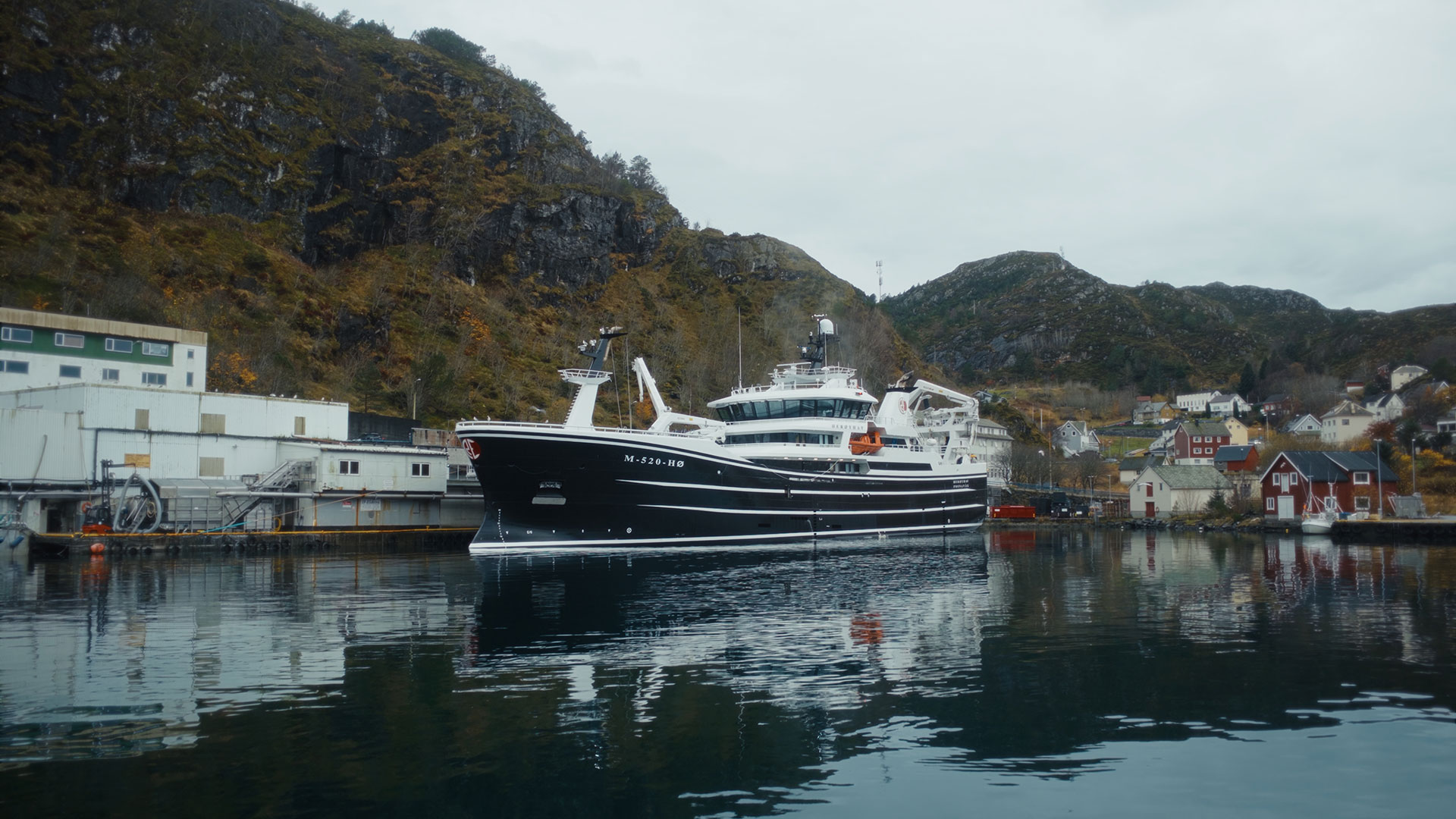
A new vessel always means change, but on board ‘Herøyhav’ it has meant something more. A shift in sound, precision and power – and in how the crew makes use of the technology on board.
The new vessel has performed from day one, and time-critical quotas have been landed without interruption – despite concerns when the delivery date was postponed.
In late summer 2025, the new ‘Herøyhav’ sailed directly from the shipyard in Denmark to the fishing grounds along the Norwegian coast. The combined trawl and purse seine vessel initially entered service in the mackerel and Norwegian Spring Spawning (NVG) herring purse seine fishery, and through late autumn 2025, trawling for North Sea herring.
We spoke with the Master, First Officer and Chief Engineer, each describing how the new electric winch and control system from Evotec has performed in real fishing operations. Evotec has delivered MultiSoft™ electric winches and the CORE™ winch drive and control system on board.
Experiences from the first part of the season are consistently positive – in terms of operational reliability, working environment and functionality in critical operations.

When all the concerns disappeared
Master Anders Remøy is clear in his assessment of the first season:
“We were excited, but it has been a fantastic season, and the vessel has performed very well. It’s a completely new world compared to hydraulics – extremely low noise, very comfortable. Going electric has been a very positive experience for us.”
Behind the success, however, lay a significant risk scenario. The vessel was delivered late, the season was already underway, and a lot was at stake – both financially and operationally.
The shipping company had previously equipped its vessels with hydraulic winches, a well-proven technology that had worked reliably for many years. ‘Herøyhav’ is the first vessel in the company’s history to be equipped with a fully electric winch and control system from Evotec. An investment that could have gone either way – especially with time-critical quotas waiting.
“We saw that the time in the fishing year was getting shorter, and we became more worried about ‘what if it doesn’t work – once we finally get the vessel – when we really need it”. The Evotec delivery was the big unknown in the equation, in a way. “If this hadn’t worked, I’m not sure we would have made it,” says First Officer Ole Ræstad.
He is quick to add: “Once the vessel was delivered and we did the first test sets and trials on board, all the concerns simply disappeared.”
Chief Engineer Stian Belden is also positive with the situation so far:
“Of course, things always come up during the commissioning phase. We’ve handled those along the way, and we’ve had good communication with all suppliers – including Evotec. If something has come up, they’ve shown up immediately with three or four people on site.”
The silent revolution
There is one aspect all three keep returning to: silence. The transition from hydraulic pumps to electric winches has transformed the working environment on board. It’s not just a pleasant bonus – it influences how they fish. Master Anders Remøy puts it like this:
“It’s much calmer to work on board the vessel. It’s a completely new world compared to hydraulics. There’s far less noise – both for the crew and for the fish.”
He explains that when mackerel migrate south through the Norwegian Sea, they often move at speeds of two to two-and-a-half knots, and ‘Herøyhav’ carefully approaches to make a precise set. In such situations, any sound can be a disturbance.
“We have to adapt and set the net ahead of the fish. In that process, noise levels are very important to avoid unsettling them. We try to move as quietly as possible around it before setting the net. The quieter it is, the more efficient the fishery becomes. With the new winches, this is very well optimised.”

The silent revolution applies throughout the vessel – in the wheelhouse, on deck and in the accommodation areas. Chief Engineer Stian Belden explains that the difference in noise is mainly due to the reduction from 13 hydraulic pumps on the old vessel to just two on the new ‘Herøyhav,’ which are used for cranes and a few auxiliary winches.
“This has a massive impact on noise levels and comfort on board. The difference is very noticeable. When we’re on deck, it’s almost silent,” he says.
A calmer working environment also has important safety implications. First Officer Ole Ræstad points out that lower noise levels make communication much easier:
“There’s almost no noise on deck – whether the winches are running or not. That means you and I can stand and talk without raising our voices at all. With electric winches instead of hydraulics, you don’t have the constant hydraulic hiss and noise. It makes it much easier for us on deck to communicate. We need to listen for other sounds, and we need to keep an eye on each other if something happens.”
He explains which sounds he can hear today that were previously drowned out – sounds that can be critical for safety:
“When we’re hauling the net, for example, we can hear if someone shouts for help – if they’ve gotten stuck or something like that. Or if the net is tearing while we’re hauling with the purse seine winch. These are sounds we can actually hear now,” says Ole Ræstad.

No hesitation – just precise response
Silence is only one side of the experience. The other is precision. On board ‘Herøyhav,’ the transition from hydraulic to electric operation is described as moving from a fossil-fuel car to an electric vehicle: no hesitation, no build-up of speed or pressure, no variation. Just precise response. First Officer Ole Ræstad explains it simply:
“The moment you touch the lever and move it a millimetre, something happens. Whether you want to adjust ten centimetres or throw out ten metres – you have full control all the way. That’s a major advantage for those of us working with large, heavy equipment that can be dangerous.”
In purse seine fishing, a set is a moment that cannot be repeated. Accurate winch response is critical to ensure controlled sets and to avoid damage to the net.
“Purse seining is a very dynamic type of fishing. We only know the general area where the fish are – or we have an idea. Then we locate the fish and try to catch them under the weather conditions we have, while estimating how much we can take. We have to be where the fish are at that exact moment, whether that’s inside a fjord or far offshore. The margins between success and failure are very small. That’s why experience in the crew – and equipment that works according to our needs – is crucial,” says Ræstad.
Ræstad describes electric operation as more predictable than hydraulic systems.
“It’s innovative – and it’s predictable. You get exactly the force you ask for.”
“Once we decide that now is the right moment to make the set and shout ‘let go’, it has to happen right then and there. The equipment must respond immediately. If you have the fish within range and something delays the response – if nothing happens until two or three hundred metres later – then the opportunity can be completely lost, and we have to start all over again.”
Master Anders Remøy also highlights that electric winches respond faster and more evenly than hydraulic ones.
“You give a command, and it happens instantly. Whether you apply 10 per cent or 100 per cent power, the winches deliver exactly what you ask for.”

The difference between a miss and a perfect set
Ræstad gives a clear example of the importance of speed and precision:
“When you’re setting on a mackerel school moving at up to four knots, and you need to deploy the net very quickly, you depend on being able to regulate winch speed precisely. The Evotec winch is extremely sensitive in this respect. You can fine-tune the speed so that you pay out exactly the right amount of wire when setting the net.”
“The biggest risk is damaging the net if you don’t slack enough wire, don’t slack fast enough, or slack too much. You need predictability when performing an operation like this. We are completely dependent on paying out wire at the same speed as the vessel is moving. The difference between a failed set and a successful one with a large catch can be many millions.”
Energy efficiency with fingertip control
Chief Engineer Stian Belden is impressed by how power is available without delay, and how operation remains smooth and predictable even under demanding conditions.
“These are very powerful winches. The efficiency of an electric motor is close to 90 per cent, and that obviously applies to this deck equipment as well. Once you get that feel – literally at your fingertips – and you know you have full torque the moment you need it, the system becomes very easy to work with.”
In addition to low noise levels and precise response, there is a significant difference in energy consumption. While hydraulic systems require pumps to run continuously to maintain pressure, electric winches only consume energy when torque and movement are requested.
“The winches have a lot of power available, but we never use more than we actually need. When we ask for little, we get little. And the power we don’t use can be allocated elsewhere. Hydraulic power units, on the other hand, constantly circulate oil through the system so everything is ready when you need it,” explains First Officer Ræstad.

Evotec CORE™ – the intelligent heart of the system
Behind glass walls in the switchboard room lies the nerve centre of the deck equipment, where frequency converters and control systems are gathered.
“This is our switchboard room. It’s tidy and easy to work in,” says Chief Engineer Stian Belden.
He explains that the room has been designed to provide a clear overview, simplifying operation and troubleshooting. From the control room, he and his colleagues monitor the system on screen throughout the entire operation.
“Through the control panel in the Evotec CORE interface, we have access to everything related to the deck equipment. We see loads and system status in real time, and if something isn’t as it should be, we can detect it early,” Belden explains.
If needed, Evotec’s service department can connect directly to the system.
“It’s a quick process to get Evotec connected. They use remote access, see exactly what we see, and can point out what isn’t quite right,” says Belden. “We’ve received support both in the evening and at night, and it has worked very well.”
He also highlights the built-in safety features of the system architecture:
“We have emergency stops everywhere, and the frequency converters include solid protection systems against overcurrent and overvoltage. That gives us confidence that the equipment will shut down before anything becomes critical,” says the Chief Engineer.
From field experience to a shared development journey
The crew on board ‘Herøyhav’ emphasise the collaboration before delivery, during construction, and in the early operational phase as a key factor in the successful transition to an electric system.
First Officer Ole Ræstad explains that the process started long before the new vessel was delivered:
“The shipowner was proactive and wanted Evotec on board early. They joined us on the old vessel to see how we worked. With people from development, control systems and sales on board, they gained a solid understanding of our needs before designing the equipment,” he says.
The experience has been one of open dialogue in both directions.
“They’ve been honest about where they had less experience, and that’s where we’ve complemented each other. We’ve explained the fishing side and how we want things done, and they’ve been very good at solving the technical side,” says Ræstad.
Chief Engineer Belden also followed the vessel’s construction in Denmark.
“We’ve had good dialogue throughout the process. During construction they were present, ensured everything was completed and delivered on time. And afterwards – if we’ve had any issues – they’ve responded immediately,” he says.
Master Anders Remøy highlights availability after the vessel entered operation:
“We fish around the clock. We’ve needed assistance on several occasions. When we’ve called, we’ve received an immediate response every time,” he says.
Next test: trawl and North Sea herring
The trawl system has so far only been trialled, but both the First Officer and the Master have clear expectations for how it will perform once North Sea trawling begins in full.
“The trawl winches are actually the part I’ve been least concerned about,” says Ole Ræstad. “We’ve trial trawled, even in poor weather, and it worked very well. I’m confident it will be just as predictable as the purse seine winches.”
North Sea herring will in some areas be fished in shallow waters, placing high demands on precise control during trawl operations as well. Experience from the mackerel and herring seasons means the crew approach this phase with greater confidence than at startup.
“If I were to build a new vessel again, I would choose electric winches without hesitation,” concludes Master Anders Remøy.
Facts about ‘Herøyhav’
The new ‘Herøyhav’ was delivered on 2 July 2025 from Karstensens Skibsværft in Skagen to Herøyhav AS, a family-owned shipping company where Master Ronald Ervik is the main owner together with his siblings Gunn and Espen, as well as senior Rolf Jarle Ervik. The vessel is 75 metres long and 16 metres wide.
The company operates a combination of trawl and purse seine fisheries. Trawling is mainly focused on blue whiting west of Ireland, while herring and mackerel are caught using purse seine. Design and interior solutions have been developed through close cooperation between the owner and the shipyard, with a strong focus on innovative solutions, optimised working conditions, and high levels of safety and comfort for the crew.
Herøyhav AS has a long-standing relationship with Karstensens Skibsværft. The previous ‘Herøyhav’ was also built in Skagen and delivered to the company in 2013.
Latest news

Remote launch and recovery of ROV in operational use with DeepOcean

One button. One touch. How ROV operations are performed from shore